¿Frenas demasiado fuerte? Cómo encontrar la presión de frenado adecuada
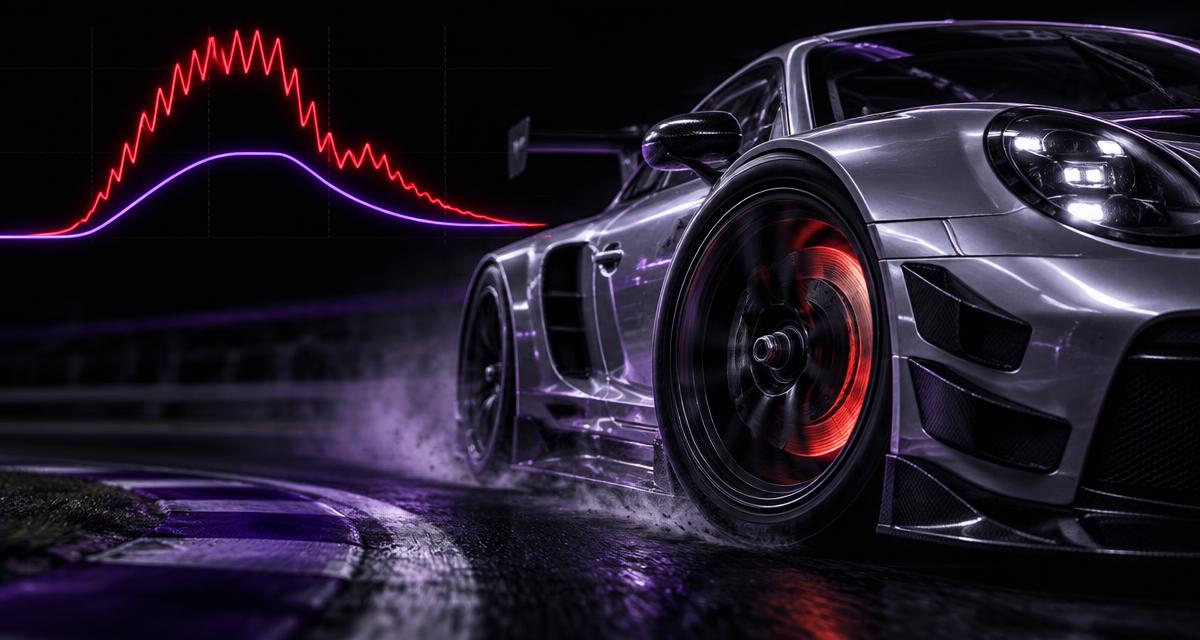
A harder brake press should stop the car faster. That sounds obvious—until you lock the front tyres, trigger ABS repeatedly, or arrive at the apex with the steering wheel turned and the car refusing to rotate.
A harder brake press should stop the car faster. That sounds obvious—until you lock the front tyres, trigger ABS repeatedly, or arrive at the apex with the steering wheel turned and the car refusing to rotate.
In sim racing, more brake pressure is not automatically more braking.
The useful question is: how much pressure can the tyres turn into deceleration right now?
The Limit Is Grip, Not Pedal Strength
Your brake pedal asks the car to slow down. The tyres decide how much of that request reaches the road.
When you brake beyond the available grip, a wheel may lock if the car has no ABS. With ABS, the system reduces brake pressure to prevent a sustained lock.
Either way, pressing harder may stop producing extra useful deceleration.
That limit changes throughout a lap. Tyre temperature, track surface, bumps, speed, aerodynamic load and steering input all matter.
In a high-downforce car, the tyres may accept very strong braking at high speed, then require less as speed—and downforce—falls.
In a low-grip car, the useful pressure may be lower from the start.
So forget the idea that every corner needs 100% brake input.
How to Tell When You're Braking Too Hard
Start with the car's behaviour, not the percentage on the pedal display.
Without ABS
A locked wheel may squeal, smoke or stop rotating in telemetry. Steering response can disappear while the tyre slides.
If this happens repeatedly at the same point, you may be exceeding the available grip.
With ABS
Frequent ABS intervention tells you the system is managing potential wheel lock.
That is not automatically a mistake. Some racing cars are designed to use ABS under heavy braking.
But if adding pedal force brings no shorter stopping distance or makes the car unstable, that extra force is not helping.
At Turn-In
If the front pushes wide while you are still braking, you may be demanding more combined braking and steering grip than the tyres can provide.
You may also simply be carrying too much speed.
Remember: A brake input trace shows what your foot requested, not exactly what the tyres delivered.
Drill 1: Find a Repeatable Reference
Choose a straight braking zone with a clear marker, preferably leading into a slow corner.
Use a familiar car and stable conditions.
Warm the tyres, then complete three clean reference laps. Use your usual braking point and normal heavy braking technique.
Notice your initial brake application, any lock-up or ABS activity, and whether you can still guide the car toward the apex.
Keep your pedal calibration unchanged throughout the test.
Record a simple baseline: braking marker, approximate peak input and whether the car reaches the corner at the intended speed.
Drill 2: Test Less Pressure, Not Later Braking
Keep the same braking marker and approach speed.
On the next run, reduce your initial peak pressure slightly.
Don't jump from 100% to 50%. Make a small change you can repeat.
For example, if your normal peak is 90%, try roughly 85% as an experiment—not as a universal target.
Repeat three laps.
Did the car remain easier to control? Did the braking distance change? Could you make the apex without additional steering corrections?
If reducing pressure makes you consistently overshoot, you have probably moved below the useful range for that situation.
If it removes lock-ups without making you miss the corner, you have learned something valuable.
Now test a small increase from your baseline, provided the car remains controllable.
Compare the results rather than assuming the harder press wins.
Drill 3: Check What Happens as Speed Falls
Finding a good initial press is only half the job.
In some cars, especially those with significant downforce, the strongest braking happens early.
As speed drops, maintaining the same pressure can push the tyres past their limit.
On a straight, try a firm initial application followed by a deliberate reduction as the car slows.
Keep steering input minimal for this test.
Do not copy a fixed pressure curve from another driver or another car.
Use tyre feedback and telemetry, if available, to decide whether your release needs to start earlier or later.
Then try the same approach in one corner, paying attention to how the car responds when you begin turning.
Measure the Corner, Not Just the Brake Zone
The shortest possible braking distance is not always the fastest way through a corner.
A hard press that forces a correction at turn-in can cost more time than it saves.
Compare entry stability, apex speed and the moment you can apply throttle confidently.
Change one thing at a time.
If you move your braking marker and alter pedal force together, you won't know what worked.
Practice the Pressure Before Your Next Session
A simulator can tell you whether a braking attempt worked. Pedal training can help you repeat the pressure you intended.
Use the Entrenador de presión de freno BrakeMaster to practise clean first-hit targets with your own pedals.
Try ten presses at a firm target, check your spread, then repeat at a slightly lower target.
The exercise develops pressure control; it does not calculate your car's ideal grip limit.
If your hardware still feels unpredictable, review Pedales de freno con célula de carga: cómo entrenar tu técnica de frenado.
For the next phase of corner entry, see Trail Braking in Sim Racing.
The best brake pressure is not the highest number you can reach. It's the pressure that helps the car slow down, stay balanced and make the corner.