
How to Improve Braking in Sim Racing
You can gain time on the brakes. But probably not in the way you think.
A lot of sim racers try to improve their braking by braking later. They move the braking point closer to the corner, hit the pedal harder and hope the lap time improves.
Sometimes it does.
But if you want to become consistently better under braking, braking later should not be your first goal.
Your first goal should be control.
Can you hit the brake pressure you want?
Can you reach it quickly without overshooting?
Can you hold it?
Can you release the pedal smoothly?
And most importantly: can you do it again on the next lap?
That is where good braking starts.
Stop Thinking Only About the Braking Point
When drivers talk about braking, the first question is often:
"Where do you brake?"
That's useful, but it is only one part of the braking process.
Two drivers can brake at exactly the same marker and still have completely different corner entries.
Why?
Because what happens after the driver touches the brake pedal matters just as much as where the braking begins.
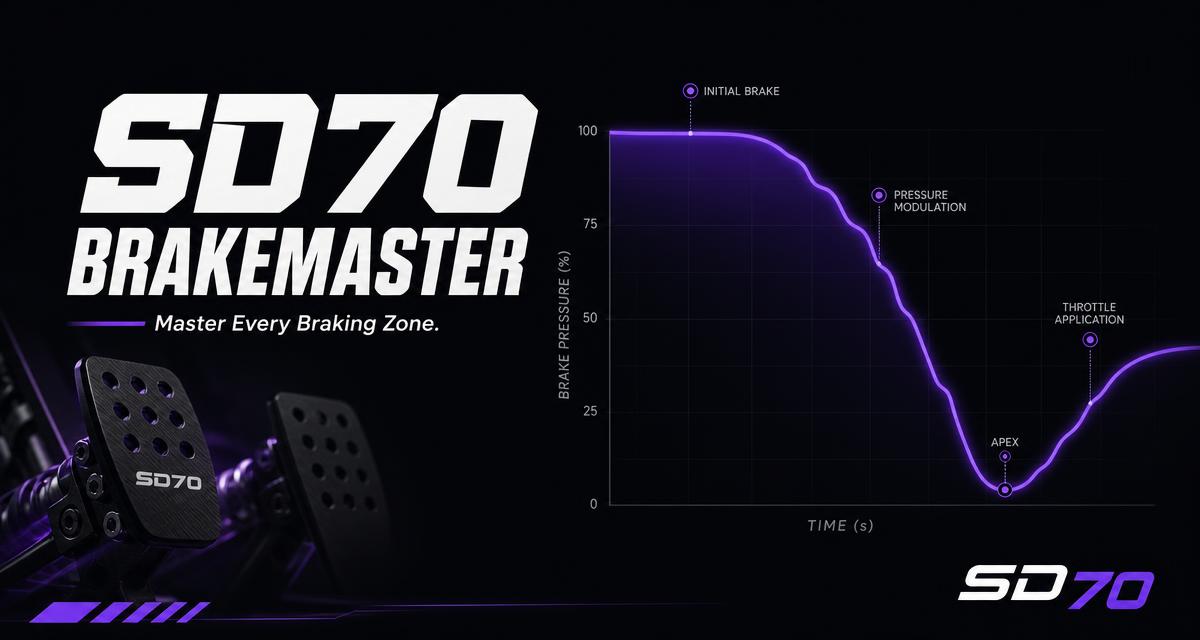
Think of braking as a sequence:
Initial brake application → peak pressure → pressure control → brake release → transition into the corner
Each part can cost you time.
If you hit the correct braking point but overshoot your target pressure, you may lock the tyres or trigger ABS unnecessarily.
If you reach peak pressure too slowly, you may lose braking performance.
If you release too quickly, you can upset the balance of the car.
If you hold too much brake while turning, you can overload the front tyres.
Good braking is not an ON/OFF action.
It is a controlled movement.
First Exercise: Learn What Different Brake Pressures Feel Like
Here's something I would ask a driver to try before changing setups or moving braking points.
Forget the track for a few minutes.
Pick a brake pressure target.
For example:
60%.
Press the pedal and try to stop at 60% without constantly watching the number.
Release the pedal.
Do it again.
And again.
Once you can hit 60% reasonably well, try:
30% → 60% → 80% → 50%
Do not chase perfect numbers yet.
The purpose is to teach your left foot that different pressure levels should feel different.
This is especially useful with a load cell brake, where you are learning to control braking primarily through force rather than pedal travel.
If 40%, 60% and 80% all feel almost the same to you, that is something worth training.
Don't Just Practice Maximum Braking
Many drivers are quite good at one thing:
100% brake.
That is the easy part.
Push hard.
But racing rarely asks your left foot to do only that.
You may need 80%.
Then 60%.
Then 35%.
Then a smooth release while steering into the corner.
The difficult part is not producing maximum force.
The difficult part is modulating that force accurately.
So don't spend all your practice time stomping on the pedal.
Train partial brake pressure too.
Brake Release Matters More Than Many Drivers Realize
Watch your braking trace.
Many drivers focus on how quickly the line goes up.
I also want to know what happens when it comes back down.
Imagine you brake hard from high speed.
You reach your peak pressure correctly.
Good.
Now you approach turn-in.
If you suddenly jump from heavy braking to zero brake, you are making a very fast change in the balance of the car.
Instead, practice controlling the release.
For example:
80% → 60% → 40% → 20% → 0%
Not because every real corner should look exactly like this.
It shouldn't.
The exercise simply teaches your foot to control the pedal in both directions.
Applying the brake is a skill.
Releasing it is also a skill.
And when you start working on trail braking, that release phase becomes even more important.
Consistency Comes Before Late Braking
Try this experiment.
Drive ten laps and look at your braking into the same corner.
Don't look at your fastest attempt.
Look at all ten.
Are you braking at roughly the same point?
Are you reaching similar peak pressure?
Is the shape of your brake release similar?
Or does every lap look different?
A single great braking zone doesn't tell me much.
If you can reproduce it repeatedly, now we have something we can work with.
Once your braking becomes consistent, you can start experimenting:
- brake slightly later;
- change peak pressure;
- release earlier;
- release slower;
- carry a little brake into the corner.
Now you are changing one variable from a repeatable baseline.
That is much more useful than simply trying to brake later every lap.
Don't Chase a Perfect Brake Percentage
Drivers often ask:
"How much brake pressure should I use?"
There isn't one percentage that works everywhere.
The correct brake input depends on the car, tyres, speed, downforce, ABS, brake setup and the corner itself.
Even during one braking zone, the amount of available braking force can change.
A high-downforce car is a good example.
At high speed, you may initially be able to use a lot of braking force because the car has significant aerodynamic load.
As speed falls, downforce decreases.
You cannot simply assume that the same pressure should be held all the way into the corner.
So don't train yourself to believe:
"80% is the correct braking pressure."
Instead, train yourself to be able to produce 80% when you want 80%, 50% when you want 50%, and 20% when you want 20%.
The simulator and the corner decide what is required.
Your job is to make your foot capable of delivering it.
A Simple Braking Practice Routine
If I wanted to work specifically on pedal control, I would separate it into short exercises.
1. Target pressure
Choose random brake pressure targets and try to hit them accurately.
Start with larger differences:
30% / 60% / 90%
Then make the targets closer together:
55% / 65% / 75%
2. Hold pressure
Reach a target and hold it.
For example:
70% for two seconds.
Watch how much your brake input moves.
This can quickly show you whether you are actually holding steady pressure or constantly correcting with your foot.
3. Controlled release
Start at a higher pressure and gradually reduce it.
For example:
80% → 60% → 40% → 20% → release
The goal is smooth control, not speed.
4. Faster transitions
Once accuracy improves, make the exercises faster.
Real braking doesn't give you five seconds to find the correct pedal pressure.
Accuracy needs to survive when the movement becomes quicker.
5. Take it back to the simulator
Now drive.
Don't try to think about ten things at once.
Pick one braking zone and one objective.
For example:
"Today I'm concentrating on a smoother release into Turn 1."
Then look at the telemetry and see whether you actually did it.
Can You Practice Braking Without Driving Laps?
Yes.
And this is one of the ideas behind BrakeMaster.
Driving laps is obviously essential. A standalone brake trainer cannot reproduce the tyres, weight transfer, downforce, track surface, corner geometry or everything else happening in the simulator.
It isn't supposed to.
The idea is to isolate one part of the driver's job:
controlling the brake pedal with the left foot.
It's similar to training a specific movement away from the full sporting environment and then bringing that skill back into the complete task.
If your problem is simply that you cannot reliably hit or hold different brake pressures, you don't necessarily need another 20 laps to work specifically on that movement.
You can isolate it.
Practice it.
Then go back to driving and see whether the control transfers to the car.
Try It With Your Own Pedals
The goal isn't to replace driving.
It's to make the time you spend driving more useful by giving your left foot another way to practice.
One Last Thing: Don't Change Everything at Once
This is probably the coaching advice I would emphasize most.
If your braking is inconsistent, don't immediately change your pedal settings, brake bias, braking point, maximum pressure, technique and car setup.
Then you won't know what helped.
Start with control.
Can you reproduce a brake input?
If yes, change one thing.
Test it.
Look at the result.
Then adjust again.
Because the fastest braking technique isn't very useful if you can only do it once every ten laps.
First make it repeatable. Then make it faster.