Trail Braking in Sim Racing: How to Release the Brake Into a Corner
A driver can brake at the right marker, hit the right peak pressure, and still lose time before the apex.

Often, the problem is what happens next.
They come off the brake all at once, turn the wheel, and wait for the car to respond. Or they keep too much pressure on the pedal while steering and wonder why the front tyres refuse to turn.
Trail braking is about managing that transition. It is not simply braking later, and it is definitely not holding the brake into every corner.
What Trail Braking Actually Does
Under braking, weight transfers toward the front of the car. That generally increases the load on the front tyres and reduces it at the rear.
As you start steering, a small amount of remaining brake pressure can help keep the front loaded and encourage the car to rotate toward the apex.
But there is a limit.
A tyre has to share its available grip between slowing the car and changing direction. Ask it to do too much of both and it slides. Depending on the car and conditions, excessive trail braking can create understeer, rear instability, or a spin.
That is why the key skill is reducing brake pressure as steering demand increases.
You are trading braking force for cornering force, not trying to maximise both.
Start With a Corner You Know
Choose a medium-speed corner with a clear braking marker and a reasonably predictable entry. Avoid a bumpy, blind corner for this exercise.
Drive five clean laps using your normal technique. Keep the same car setup, fuel level if practical, and braking marker.
Pay attention to three things:
- Where you begin releasing the brake.
- When you first add steering.
- Whether the car reaches the apex without extra steering corrections.
Do not chase your fastest lap yet. You need a baseline.
Drill 1: Release Before Turn-In
On your first set of attempts, complete most or all of the braking while the wheel is straight.
Release the pedal, then turn in.
This gives you a simple reference. The car may feel stable, but perhaps reluctant to rotate or slightly slow at the apex.
That is useful information.
Repeat the corner several times until you can recognise the same entry feeling. If you are missing the apex, fix your speed and line before introducing trail braking.
Drill 2: Carry a Little Brake Into the Corner
Now keep the same braking marker and roughly the same initial pressure.
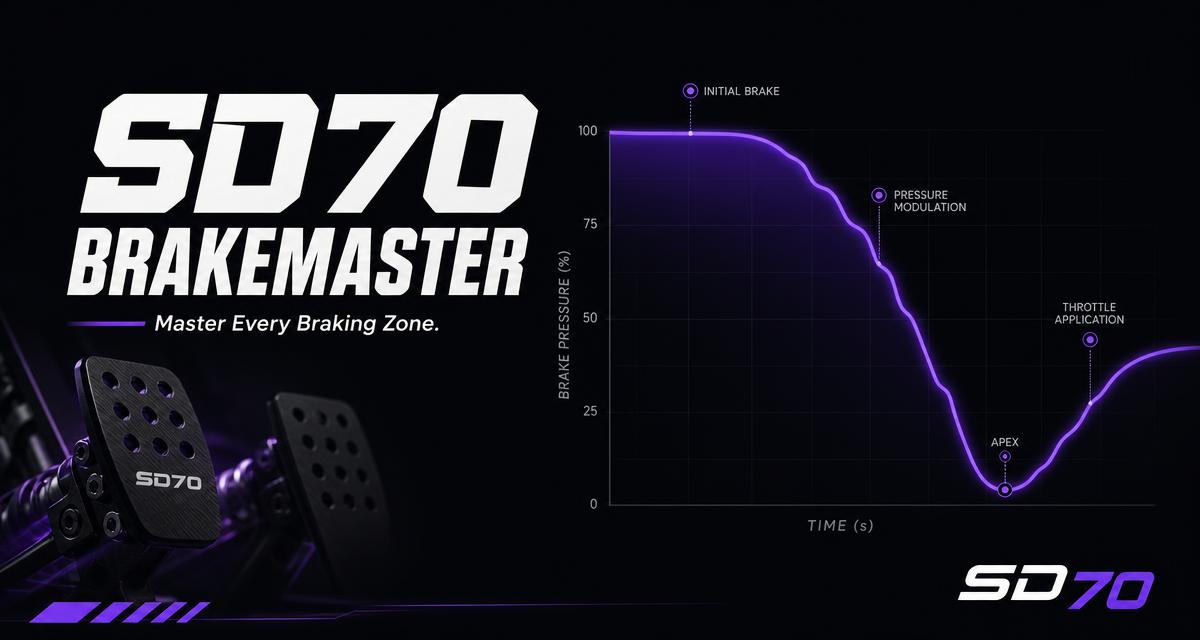
As you approach turn-in, begin releasing the brake progressively rather than lifting your foot in one movement.
Carry a small amount of pressure into the first part of the steering input, then continue releasing as steering angle builds.
Think more steering, less brake.
For a first exercise, it can help to imagine a sequence such as 60% → 30% → 10% → 0%. Those are training references, not a pressure recipe for every car or corner.
Try five laps.
If the car turns more willingly without becoming nervous, you may be finding a useful balance. If it pushes wide or the rear starts to move unexpectedly, reduce the overlap between braking and steering.
Drill 3: Change Only the Release Timing
This is where practice becomes useful rather than random.
Keep your braking point and entry speed as consistent as possible. On one run, finish releasing slightly earlier. On another, hold a small amount of pressure slightly longer.
Do not change the braking point, peak pressure, steering timing, and racing line all at once. You will not know which change helped.
Look for an entry that lets you point the car toward the apex with less correction and get back on the throttle cleanly.
The fastest-looking entry is not always the quickest corner. A car that rotates sharply but compromises the exit may lose more time down the next straight.
Read the Car, Not Just the Brake Trace
A smooth downward brake trace is a useful sign of control. It is not proof that the technique is correct.
Compare it with what the car does.
Front tyres washing wide? You may be asking for too much braking and steering at once, or arriving too fast.
Rear becoming nervous? The combination of forward weight transfer, steering and reduced rear grip may be too aggressive.
Car turning cleanly but exit speed suffering? You may be holding the brake longer than the corner needs.
Different cars need different approaches. A high-downforce formula car, an ABS-equipped GT car, and a low-grip road car will not reward identical inputs.
And some corners are better driven with little or no trail braking at all.
Train the Release Away From the Track
Before your next session, spend five minutes on controlled brake release with your own pedals.
Start from a comfortable firm pressure, then reduce it in smooth stages without staring at the input bar. Check the result after each attempt.
Once that feels repeatable, practise one continuous release. The goal is not a perfect graphic; it is a left foot that can ease off the pedal deliberately.
You can work on this in the BrakeMaster Trail Braking Trainer.
For a broader foundation, read How to Improve Braking in Sim Racing, or revisit Load Cell Brake Pedals: How to Train Your Braking Technique if your pedal still feels unfamiliar.
Then return to one corner and test what you learned.
Good trail braking is not about keeping your foot on the brake longer. It is about knowing exactly when—and how—to let go.