How to Brake More Consistently in Sim Racing
Stop trying to find another tenth. First, learn to repeat the good lap.
One lap, you get the braking perfectly right.
The car slows down exactly as you expected. You hit the apex, get back on the throttle early, and gain two tenths.
Next lap, same corner.
You brake a little too late, release the pedal too quickly, and run wide.
Third lap, you brake earlier to compensate.
Now you're losing time again.
Sound familiar?
Here's what I would tell a driver in that situation:
Stop trying to find another tenth. First, learn to repeat the good lap.
Because if you can only execute a braking zone correctly once every five laps, you don't really have control of that braking zone yet.
You have one good attempt.
And racing demands more than that.
Your Best Braking Zone Is Not Always Your Best Braking Technique
Imagine two drivers approaching the same corner.
Driver A occasionally brakes extremely late and gains a tenth. But every few laps, they overshoot the corner or compromise the exit.
Driver B brakes slightly earlier but consistently gets the car slowed down, rotated and positioned for a good exit.
Who would I rather work with?
Driver B.
Not because braking earlier is automatically better.
It's because Driver B has a repeatable technique.
We can improve that technique gradually.
With Driver A, we first need to understand why the braking changes so much from one lap to another.
A single fast corner doesn't tell the whole story.
Consistency gives us something we can build on.
Find a Braking Reference You Can Actually Repeat
Let's start with the braking point.
Many drivers use distance boards, kerbs, barriers or changes in the track surface as braking references.
That's fine.
But your reference needs to be something you can identify reliably while driving at speed.
If you're constantly guessing where to brake, every braking zone begins with uncertainty.
Choose one corner and one clear reference.
For example, a 100-metre board.
I'm not saying you should always brake at 100 metres. That's just an example.
Drive several laps using that reference.
Don't move it yet.
Your first job is to find out whether you can begin braking at approximately the same place every time.
If your braking point is changing by several metres on every lap, don't immediately blame your brake pedal.
You may simply be inconsistent in recognizing and reacting to your reference.
That's a different problem, and it needs a different solution.
The Braking Point Is Only the Beginning
Now imagine you're hitting the same braking marker every lap.
But your corner entry is still inconsistent.
What should we check?
The brake application.
Two drivers can brake at the same point but produce completely different deceleration.
Even the same driver can do this from one lap to another.
One lap, you apply the brake firmly and reach the required pressure quickly.
Next lap, you hesitate slightly.
Another lap, you hit the pedal too aggressively and trigger ABS or lock a tyre.
The braking marker hasn't changed.
The movement of your foot has.
This is why I don't like coaching braking by looking only at where the driver starts braking.
I want to know what happens immediately afterward.
Exercise 1: Five Laps, One Braking Zone
Here's a simple exercise.
Choose a circuit you know reasonably well.
Pick one braking zone with a clear reference.
For the next five laps, forget about improving your overall lap time.
Concentrate on that single corner.
Use the same braking reference and aim for a similar initial brake application.
Don't deliberately brake later.
Don't experiment with the setup.
Don't change your brake bias halfway through.
Just drive five laps.
Then compare what happened.
Did you start braking in approximately the same place?
Was your initial brake application similar?
Did the car slow down predictably?
Did you reach the corner at a similar speed?
Was your exit consistent?
If you have telemetry, compare the brake traces.
If you don't, pay attention to the car's behaviour and your corner entry.
You don't need expensive equipment to begin recognizing inconsistent braking.
You need to pay attention to the right things.
Don't Confuse Consistency With Identical Inputs
There's an important distinction here.
I'm not asking you to reproduce an identical brake trace regardless of the situation.
That would be a mistake.
Tyre temperature changes.
Fuel load changes.
Grip changes.
Your approach speed may be slightly different.
The car may need a different braking input because the conditions are different.
Good braking consistency means producing a predictable result with the appropriate input.
It doesn't mean blindly pressing the pedal to the same percentage every lap.
If you approach a corner faster than usual, the braking demand changes.
If the tyres have less grip, you may need to adjust.
The goal is not robotic repetition.
The goal is controlled, repeatable execution with the ability to adapt.
Exercise 2: Compare the Good Lap With the Bad One
Now let's do something useful with your telemetry.
Find two laps.
One where you were happy with the braking.
One where you made a mistake.
Compare the same corner.
Don't start by looking at the total lap time.
Look at the braking itself.
Did You Brake at the Same Point?
If the braking point changed significantly, start there.
Did You Reach Peak Pressure Differently?
Maybe one lap you reached the required pressure quickly.
On the other, your initial application was too slow or too aggressive.
What Happened During Brake Release?
This is often where the interesting differences appear.
You may have reached almost identical peak pressure on both laps.
But on the slower lap, you released the brake too early.
Or held too much brake pressure while trying to turn.
That changes how the car enters the corner.
Don't assume every inconsistency comes from the initial braking point.
Sometimes the problem happens much later in the braking zone.
Brake Release Can Make or Break Your Corner Entry
Here's something I often want drivers to understand.
The brake pedal isn't just there to slow the car.
Your braking also influences the car's balance.
During braking, load transfers toward the front axle.
As you release the pedal, that load transfer changes.
How you release the brake can influence how the car responds when you begin turning.
This is one reason why brake release deserves so much attention.
Imagine two laps.
On the first lap, you progressively reduce brake pressure as you approach the apex.
On the second, you suddenly release the pedal while the car is still entering the corner.
Even if your braking point and peak pressure were identical, the car may behave differently.
The correct release depends on the corner and the car.
But the ability to control that release should not be left to chance.
Exercise 3: Work on One Part of the Braking Zone
For this exercise, keep your braking point unchanged.
Keep your initial brake application approximately the same.
Now concentrate on the release.
Drive five laps.
Try to make the release controlled and appropriate for the corner.
Don't force the same release duration if the approach conditions change.
Instead, pay attention to how smoothly and predictably you can reduce braking pressure.
Ask yourself:
Did I release because the car was ready to turn?
Or did I release because I always release at that exact spot?
That's an important difference.
Good drivers don't just memorize movements. They learn when those movements are needed.
When You Make a Mistake, Don't Immediately Change Everything
This is one of the most common problems I see in practice.
A driver misses a braking point.
Next lap, they brake ten metres earlier.
Now they're too slow.
So they move the braking point forward again.
Then they change brake bias.
Then they adjust pedal sensitivity.
After ten laps, they've changed five things and still don't know what caused the original problem.
Don't train like that.
When you make a mistake, first identify what actually happened.
Was the braking point wrong?
Was the initial pressure wrong?
Did you release too early?
Was your approach speed different?
Did the car have less grip?
Find the cause before changing the solution.
One mistake doesn't always mean your technique needs changing.
Sometimes it's simply a mistake.
Consistency Under Pressure Is a Different Challenge
There's another part of braking consistency that becomes important during racing.
Pressure.
In qualifying, you may have a clear track and plenty of space.
During a race, there's another car directly behind you.
Or you're following someone into a corner.
Suddenly, the same braking zone feels different.
You may brake too late because you're concentrating on the car behind.
Or brake too early because you're worried about contact.
This is where reliable technique helps.
If your braking is already inconsistent during practice, adding traffic and pressure usually makes the problem harder.
That's why I like building a stable technique before asking a driver to perform it in more demanding situations.
First, learn to execute the braking zone alone.
Then practice it with traffic.
Then work on maintaining that control during close racing.
Remember that following another car can also change your visual references and the available grip. Consistency doesn't mean ignoring those differences.
It means responding deliberately instead of panicking.
A 15-Minute Braking Consistency Session
You don't need to spend two hours working on one corner.
Sometimes fifteen focused minutes are more useful than fifty laps without a clear objective.
Here's how I would structure a short session.
Minutes 1–5: Establish Your Reference
Drive normally.
Choose one braking zone.
Identify a reliable braking marker and pay attention to your initial brake application.
Don't chase lap time.
Minutes 5–10: Repeat the Braking Zone
Keep your reference stable.
Concentrate on making the braking process predictable.
Notice whether your mistakes come from the braking point, pressure application or release.
Minutes 10–15: Review and Adjust
Look at your telemetry if available.
Identify one recurring problem.
Make one small adjustment.
Then test it.
Don't change everything at once.
At the end of the session, you should be able to explain what you were working on and whether it improved.
If you can't, your practice probably wasn't focused enough.
What If Your Left Foot Is the Problem?
Sometimes the driver understands exactly what they want to do.
They know the braking point.
They know how much braking they need.
They understand the release.
But their foot doesn't consistently produce the intended input.
That's where isolated pedal training can help.
For example, if you're trying to reach a particular brake pressure but constantly overshoot or undershoot it, you can practice that movement away from the track.
The goal is to improve your ability to control the pedal without also having to manage steering, traffic and corner entry.
We covered this in more detail in our previous article, How to Improve Brake Pressure Control in Sim Racing.
Isolated training doesn't replace driving.
It gives you another way to work on a specific weakness before returning to the simulator.
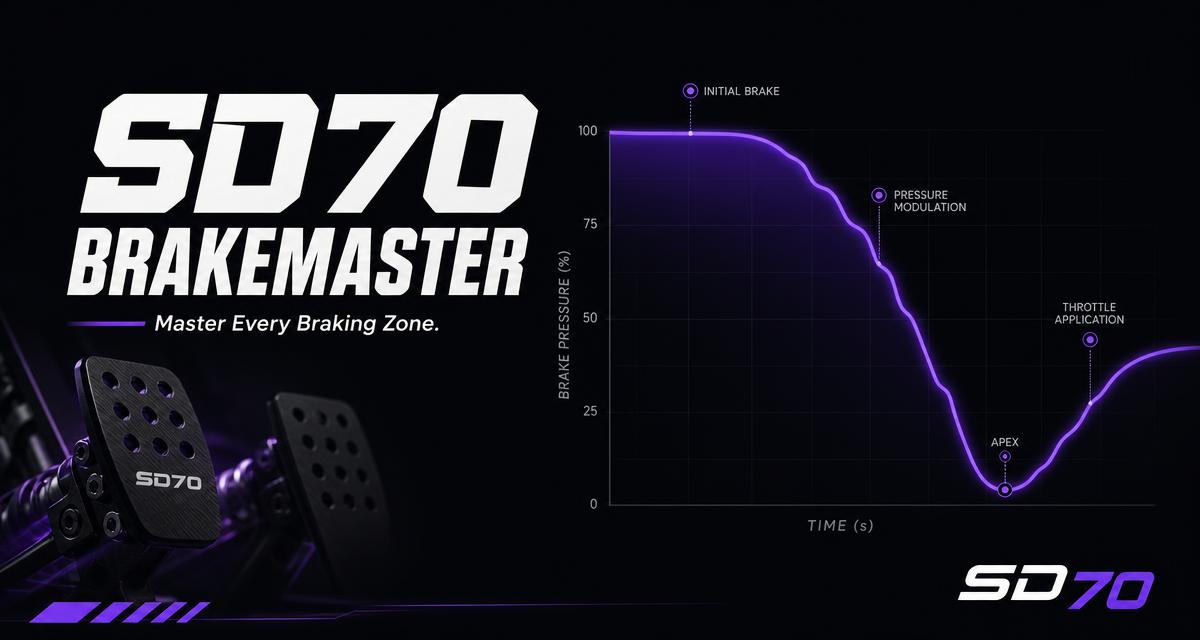
Practice Your Brake Control With BrakeMaster
If inconsistent pedal inputs are part of your problem, spend a few minutes training your left foot separately.
The BrakeMaster Brake Pressure Trainer lets you practice reaching different brake pressure targets using your own sim racing pedals.
You can work on the accuracy of your inputs without having to drive an entire lap between attempts.
Try the Brake Pressure Trainer
Then return to your simulator.
Choose one braking zone.
Drive five laps.
See whether you can produce a more repeatable braking input.
That's the important part.
We're not trying to become good at a pedal exercise for its own sake.
We're trying to develop a skill that can support better driving.
One Final Piece of Advice
The next time you set a personal best, don't immediately try to beat it.
Try to repeat it.
Look at the braking zones where you gained time.
Understand what you did.
Then see whether you can do it again.
Because in racing, one perfect lap is useful.
But being able to produce good laps consistently?
That's what makes you a stronger driver.