Load Cell Brake Pedals: How to Train Your Braking Technique
If you have just moved from a basic brake pedal to a load cell, the first few sessions can feel strange. You press harder, the pedal barely moves, and your braking points suddenly become inconsistent.
That does not mean the pedal is wrong. It means your left foot is learning a different reference.
A load cell measures force rather than relying mainly on pedal travel. That can make repeatable braking easier, but only after you set it up sensibly and practice using it.
Buying the pedal is not the training.
Start With a Pedal You Can Control
Before chasing lap times, check your driving position. Your seat and pedals should stay put when you brake hard. If your chair rolls backwards, your body is absorbing part of the effort, and your inputs will vary.
Next, calibrate the pedal's maximum force.
Choose a setting you can reach firmly, repeatedly, without lifting yourself out of the seat or straining your leg.
Maximum pressure should feel deliberate, not like a one-rep gym exercise.
Check the brake output in the pedal software and the simulator. Make sure a normal firm press reaches the intended range, and avoid large dead zones or aggressive curves unless you have a clear reason for them.
Then leave the settings alone for a few sessions.
Changing the maximum force every time you miss a corner prevents your foot from learning a stable reference.
Drill 1: Learn the Force Range
Do this with the car stationary or in a pedal-training tool.
Press the brake gently, then moderately, then firmly. Release fully between attempts.
Don't worry about hitting exact percentages yet.
Feel the difference between light, medium and heavy effort. Repeat each level five times.
Now check the input display.
Are your medium presses grouped together, or does one register 35% and the next 75%?
If they vary widely, slow down. Make each press intentional.
The aim is to build a useful mental scale for the pedal.
A Simple Rule: One Press, Then Feedback
Avoid creeping up to the number while watching the bar.
Make the input, check the result, release, and try again.
That trains your foot to choose a force, not your eyes to steer it.
Drill 2: Control the First Hit
In a heavy braking zone, the first fraction of a second matters.
An uncertain press can cost distance; an uncontrolled stomp can trigger ABS or lock a wheel, depending on the car.
Choose three target inputs in your pedal trainer, such as 40%, 65% and 85%.
Hit each target with one clean press, then release.
Mix up the order so you cannot simply repeat the same movement.
Do ten attempts.
Note whether you usually overshoot, undershoot or scatter around the target.
Don't chase perfect numbers.
Look for a smaller spread of results.
Drill 3: Train the Release, Not Just the Push
A common load-cell mistake is concentrating so much on pressing hard that the release becomes an afterthought.
Start at a firm input, around 80% on your calibrated display.
Reduce it to about 50%, then 20%, then zero.
At first, pause briefly at each step. Once you can control the steps, try a continuous, progressive release.
Keep your heel and leg position comfortable.
Don't let your foot snap off the pedal just because the hard braking phase is finished.
This drill is not a universal corner-entry brake trace.
It is a way to teach your leg that reducing force is a controlled action.
Take the Skill Back to the Track
Choose one familiar corner with a clear braking marker.
Drive five laps without changing the car setup or pedal calibration.
Focus on three questions:
- Did I reach the intended initial pressure cleanly?
- Did the brake release feel deliberate?
- Did the car arrive at turn-in in a predictable state?
Compare your brake traces if you have telemetry.
If you don't, watch your brake input display in a replay and pay attention to the car's behaviour.
Do not assume the highest peak pressure or latest braking point is the best lap.
Your job is to connect a controlled pedal input with a better corner entry and exit.
Three Mistakes That Slow Progress
Setting the pedal too stiff.
If you cannot reach your chosen maximum force consistently, reduce it. You can increase it later if there is a reason.
Changing hardware settings after every bad lap.
First decide whether the problem is calibration, technique or track conditions.
Practising only maximum braking.
Most corners also demand a controlled reduction in pressure.
A strong left foot is useful; a precise one is better.
Practice With BrakeMaster
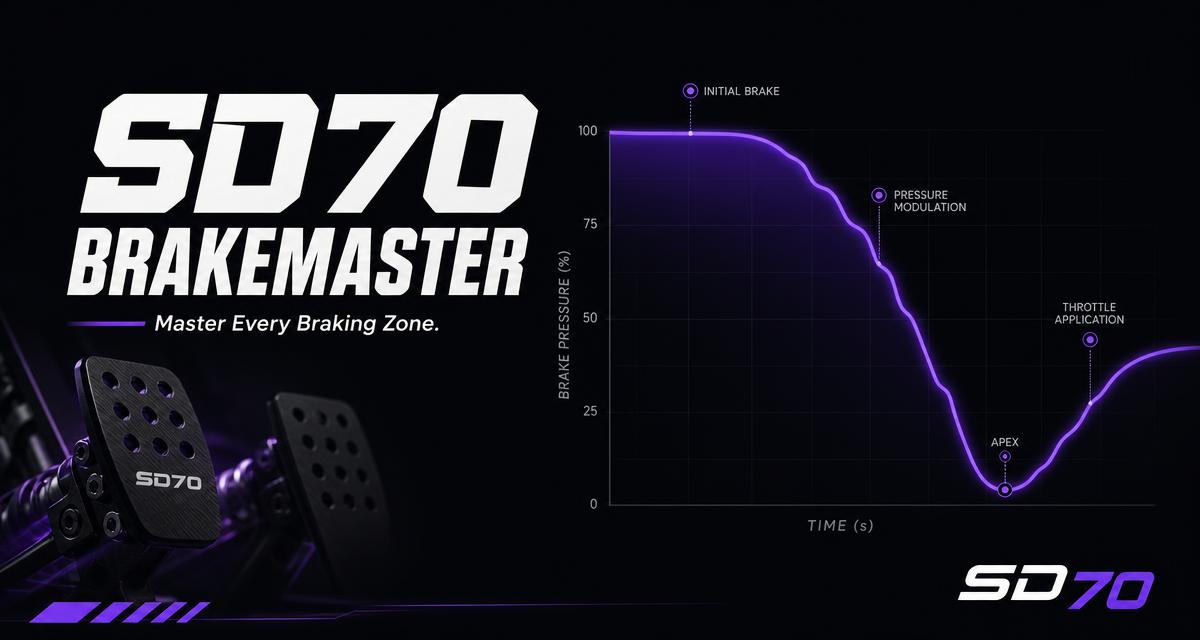
The BrakeMaster Brake Pressure Trainer lets you work on target pressure with your own pedals, away from traffic and lap-time pressure.
Try a short set of first-hit targets, then return to your simulator and work on one braking zone.
For more on target accuracy, read How to Improve Brake Pressure Control in Sim Racing.
If your laps still vary, see How to Brake More Consistently in Sim Racing.
A load cell gives you a force-sensitive tool.
Training teaches you how to use it.
The goal isn't to press harder. It's to press on purpose—and release with the same care.